
Assets & Risk
Before Your First Crypto Purchase: How to Tell If You Can Afford to Lose the Money
Four checks to run before your first order, a pen-and-paper way to set your maximum acceptable loss, and the losses beyond price drops that belong inside that limit.
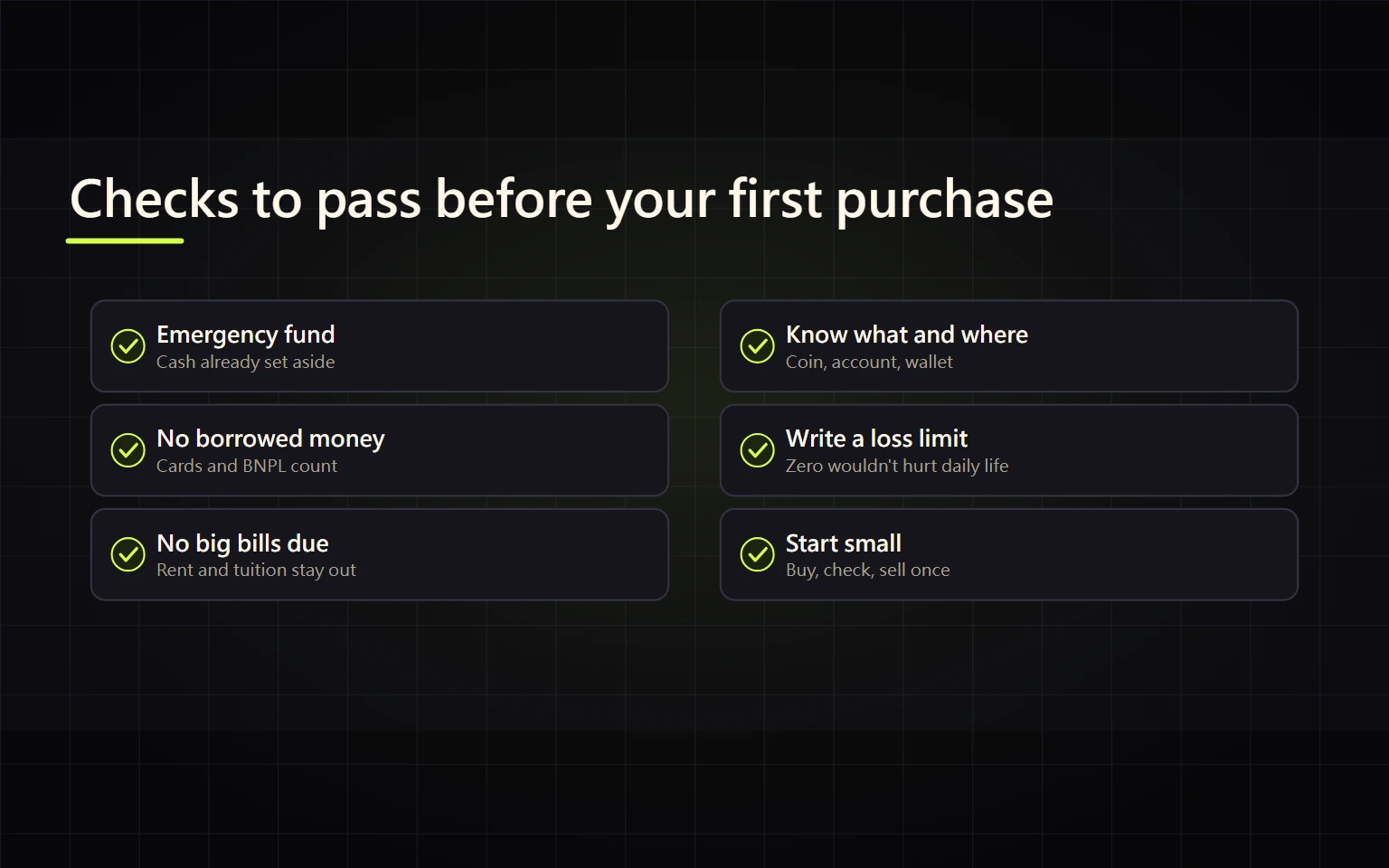
Most people buying crypto for the first time start with "which coin should I buy?" A better first question is: if this money dropped by half, or never came back, would your daily life be affected? This guide skips price predictions. It gives you a few checks you can do yourself before your first order, so you can decide whether this money belongs in crypto at all, and how much at most.
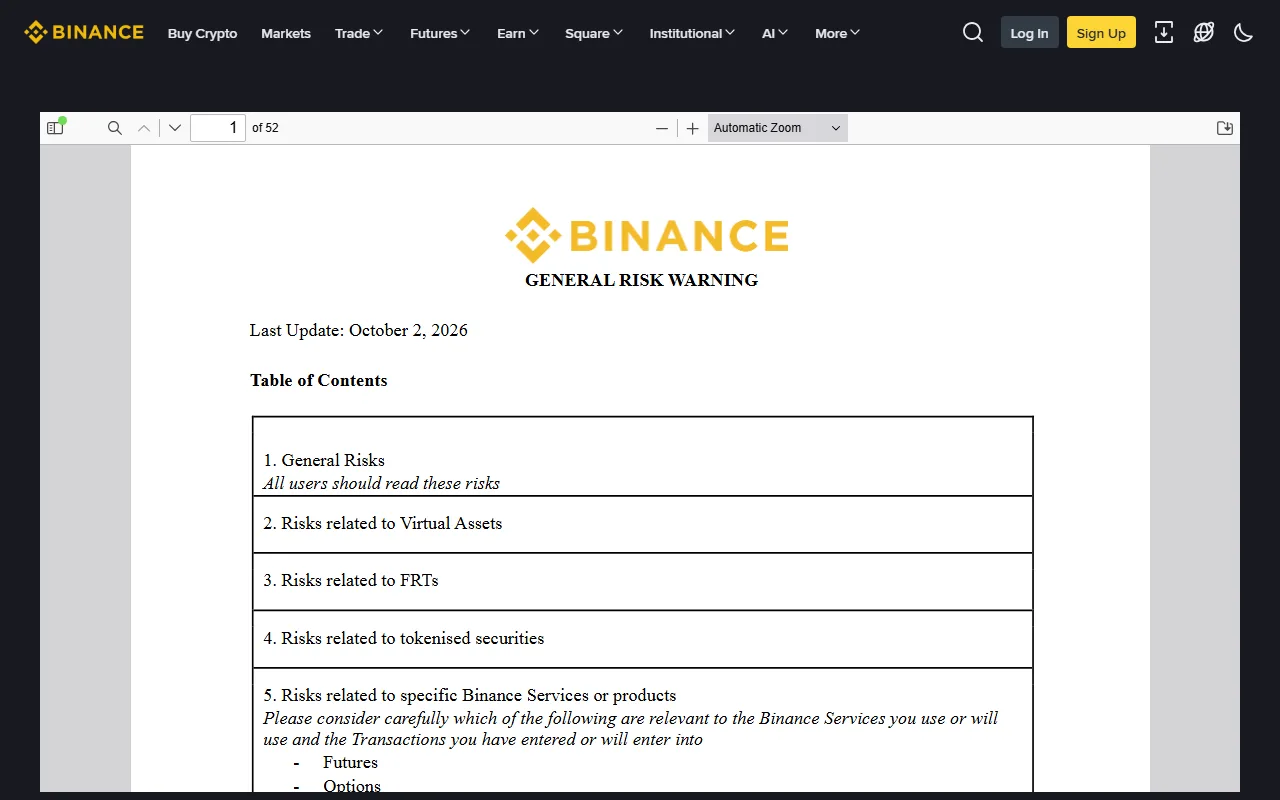
Source: Binance risk warning page (binance.com/en/risk-warning), screenshot taken 2026-10-13. The document is 52 pages long; section 1 is marked "All users should read these risks".
What the platform itself says: you may not get your money back
The risk notice in Binance's site footer is blunt: virtual asset prices can be volatile, the value of your investment may go down or up, and you may not get back the amount invested. It also says you are solely responsible for your investment decisions and that Binance is not liable for trading losses you may incur.
The full version is the General Risk Warning shown above, currently dated October 2, 2026. Before your first purchase, read at least section 1 (General Risks) and section 2 (Risks related to Virtual Assets). These are the terms you agree to when you open an account, not boilerplate.
Everything below starts from one assumption: plan as if losing all of it is a real outcome, not a freak event.
Four checks first. If any one fails, wait
- Your emergency fund is already set aside. Job loss, illness or a car repair shouldn't depend on selling crypto. If you don't yet have cash you can reach quickly, build that first.
- None of it is borrowed. Credit card cash advances, buy-now-pay-later and loans from family all count. Debt has to be repaid with interest even if prices fall, which magnifies losses.
- You have no fixed bills due soon. Tuition, rent, taxes or a wedding you must pay for in the next few months shouldn't sit in an asset that can swing sharply in a short time.
- You know what you're buying and where it will sit. At minimum: which coin, which account you're buying with, and whether it ends up in the exchange account or your own wallet. If that's still unclear, start with the Binance beginner roadmap from sign-up to first spot trade.
Work out your maximum acceptable loss
No formula needed, just a sheet of paper:
- Write down your fixed monthly income and essential spending, and find what is genuinely free each month.
- From that free amount, subtract what you already planned to save.
- For what's left, ask: if this went to zero, would I have to change how I live, delay a payment or borrow? If yes, lower the number.
Worked example (method only): say 300 units of your local currency are free each month, 200 of which you plan to save, leaving 100. If losing that 100 only means fewer meals out and no missed bills, 100 is your limit for the month. If losing it would leave your next card bill unpaid, the limit is lower.
The right number differs for everyone, and we won't suggest a percentage. What matters is writing the limit down before choosing how much to buy, not after watching the price rise.
Losses don't only come from falling prices
Beginners tend to think only of price drops. Several other sources of loss belong inside your limit too:
- Trading costs: fees, the bid-ask spread and slippage on market orders, which add up quickly on small, frequent trades. See Binance fees, spread and slippage explained.
- Mistakes: the wrong network, a mistyped address or a missing memo. On-chain transfers usually can't be reversed.
- Account and scam risk: account takeovers, fake support agents, and scams that demand an upfront "unlock fee" before a withdrawal; see how to spot withdrawal tax and unlock fee scams.
- Liquidity and availability: when you want to sell, thin markets can mean a worse price, and the services or fiat options in your region can change. What you can actually use is whatever you see after logging in.
Final checklist before you place the order
- The amount is at or below the loss limit you wrote down
- All four checks above passed
- You've read sections 1 and 2 of Binance's risk warning
- Your first purchase is small, so you can practise buying, checking the balance and selling end to end
- You've noted the time, quantity, price and fee of each purchase for later records
FAQ
Can I lose money holding only stablecoins? Stablecoins aim to track a currency's value, but that doesn't mean they can't drift, and platform, issuer and operational risks still apply. Don't treat them as a bank deposit.
If it drops and I just hold, is it a loss? A lower value is real exposure even before you sell. If a drop would cost you sleep, or force you to sell because you need the cash, you've put in more than you can afford to lose.
Can I borrow to buy and repay after it goes up? That's not a good idea. The debt doesn't shrink when prices fall, which is exactly what checks one and two are there to rule out.