
Assets & Risk
Exchange Account vs Self-Custody Wallet: Who Controls Your Crypto and Who Can Help
Tell an exchange account from a self-custody wallet by asking who holds the private keys, and see who can help when you forget a password, lose a phrase or send to the wrong address.
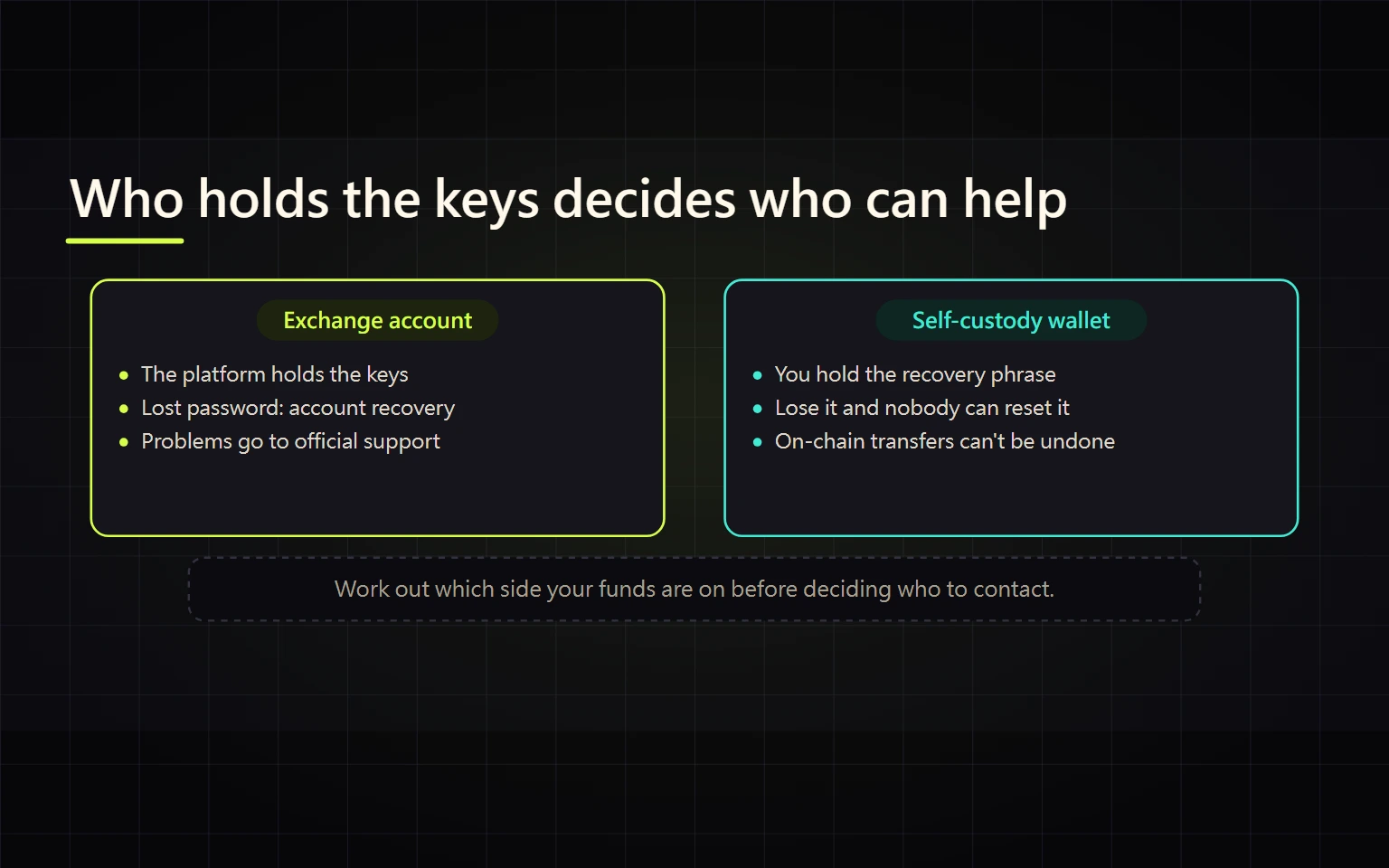
Coins in an exchange account and coins in your own wallet both look like "my crypto" on screen. When something goes wrong, though, the people who can help you are completely different. This guide follows one question throughout: who holds the private keys? The answer decides who can move your assets, who can help you recover them, and who you should contact.
Source: Binance Academy article page, screenshot taken 2026-10-12. The definitions below follow this article.
The one-line test: who keeps the keys
Binance Academy puts it plainly: with a custodial wallet, a third party such as an exchange holds and manages the private keys for you. With a non-custodial (self-custody) wallet, you generate and store the keys yourself.
In everyday terms:
- An exchange account (for example, your Binance Spot account): you log in to an account, not a wallet. The balance you see is what the platform's ledger credits to you; the coins on-chain sit in wallets the platform controls.
- A self-custody wallet (for example, a mobile wallet that gave you a recovery phrase when you set it up): there is no account to log in to. Whoever has the recovery phrase or private key can move the funds at that address.
A quick check: did setup ask you to write down a recovery phrase? If yes, it is most likely self-custody. If you can get back in with email, password and 2FA, it is most likely custodial. An exchange app may also have a separate wallet section that is not the same thing as your exchange account — see Where Are My Funds on Binance?.
The same problem, two different outcomes
| Situation | Exchange account (custodial) | Self-custody wallet |
|---|---|---|
| Forgot password or changed phone | Use the platform's account recovery, usually with identity checks | Only your own recovery phrase restores access; without it, nobody can reset it |
| Recovery phrase or private key leaked | Not applicable (you don't hold the key) | The other person can move your funds; nothing can be frozen or reversed |
| Account taken over | Contact the platform to lock the account and review logins and withdrawals | There is no account; move whatever is left to a new wallet fast |
| Withdrawals paused or account restricted | You wait or follow the platform's appeal process | No single platform can block you, but blockchain rules still apply |
| Sent to the wrong network or address | If the receiver is a platform, you can ask whether it has a recovery process | It is an on-chain transaction; the wallet developer cannot undo it |
| The platform itself runs into trouble | You carry the platform's credit risk (Academy calls it counterparty risk) | Not affected, provided your keys are safe |
The Academy article is explicit about the trade-off: if you lose both your device and your recovery phrase, your funds are permanently inaccessible, and there is no customer support team that can recover them.
Who to contact when something goes wrong
Put the problem in the right box first, then decide who to contact:
- The funds are in your exchange account (strange logins, withdrawal on hold, a deposit not credited) → contact only the platform's official support or ticket system. For reaching a human agent and chasing an unanswered ticket, see How to Reach a Human at Binance Support.
- The funds are in a self-custody wallet (the app won't open, the balance is missing) → check that your recovery phrase is complete and that you are looking at the right network. Wallet developers can usually help with the software, not with recovering your keys.
- Funds were moved out of your wallet → nobody can reverse an on-chain transaction. Move what remains to a wallet created with a new recovery phrase, and keep the TxID, time and addresses for any report you file later.
- Someone reaches out offering to "recover" or "unfreeze" funds → for either type of wallet, genuine support never asks for your recovery phrase, private key, or an upfront fee.
How to choose: it isn't either/or
Most people use both. What matters is knowing where each amount sits and who is responsible for it:
- Money you trade with or are still learning on: an exchange account is simpler and has a recovery process. You accept the platform's credit risk, so finish your account security settings. To see what a platform can and cannot prove about its holdings, read What Proof of Reserves Can and Can't Prove.
- Money you hold long-term or use on-chain: self-custody gives you full control, provided you can store the recovery phrase reliably. Before moving larger amounts, read How to Back Up a Seed Phrase Safely and practise a restore with a small amount.
If you can't yet say who holds the keys for a given balance, don't rush to move it. List what you hold on the exchange asset page and in each wallet first, then decide.
Checklist before you move funds
- I know whether this balance is in an exchange account or a self-custody wallet
- For self-custody, I have a complete offline copy of the recovery phrase and have tested a restore
- For the exchange account, 2FA is on and I know the official support entry point
- Moving from the exchange to my own wallet is an on-chain withdrawal: I checked the network, address and any Memo/Tag, and sent a small test first
- I treat anyone asking for my recovery phrase or an "unfreeze fee" as a scam signal
Sources
Checked on 2026-10-12:
Risk note: This is general educational content, not investment or legal advice. Account recovery, freezes and appeals depend on your location and what your account actually shows.