
Assets & Risk
Why Your USD Portfolio Value Is Not Your Withdrawable Balance
A dollar portfolio total is not the same as cash you can withdraw. Separate valuations, stablecoins, cash balances, and restricted funds, then reconcile the difference with a worked example.
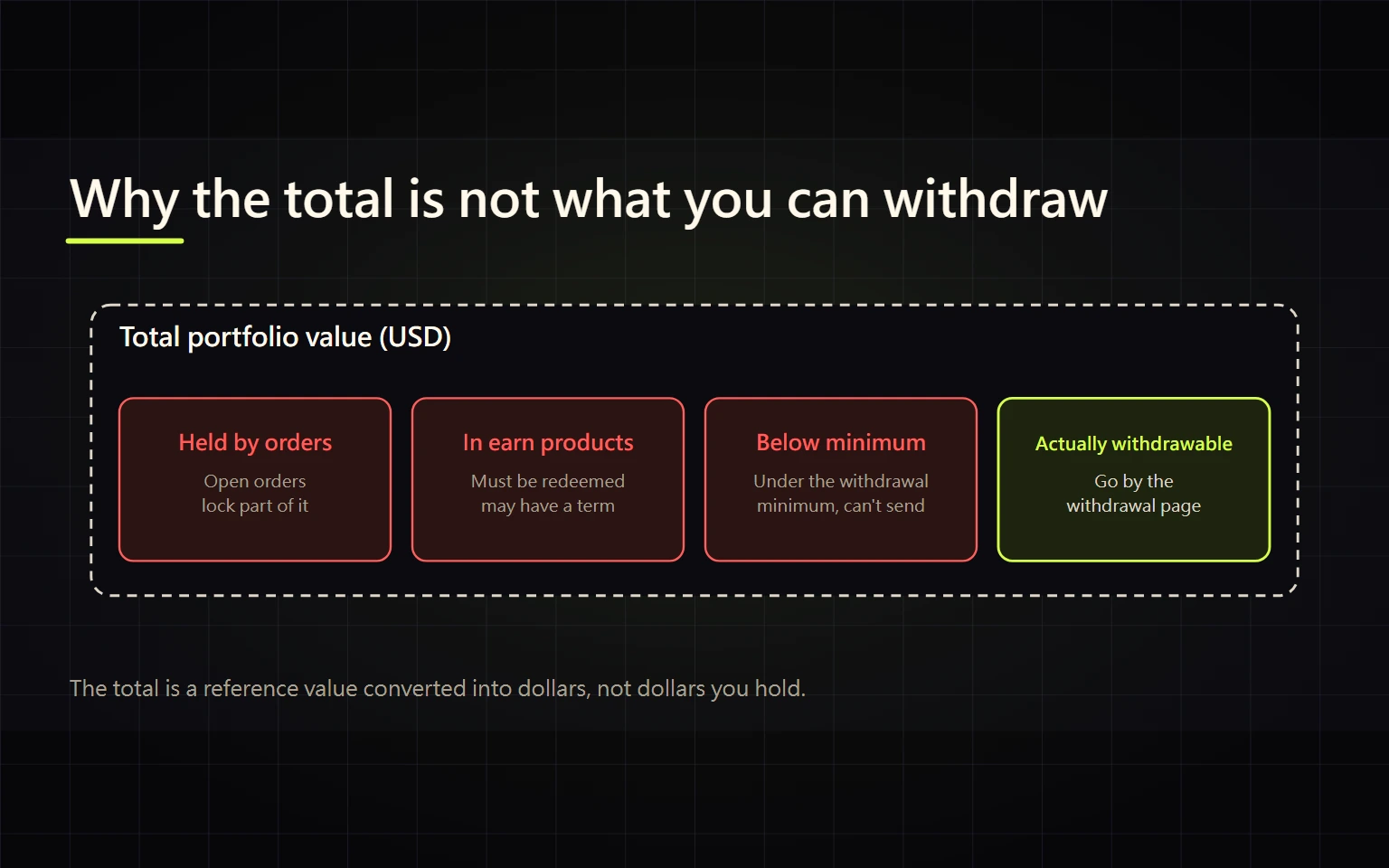
A USD portfolio value is an estimate of what your assets are worth when expressed in US dollars. It does not mean you hold that amount in dollars, or that you can withdraw it to a bank now. If your portfolio shows $1,000 but the withdrawal screen shows $200, check the assets, their location, and any restrictions before doing anything else. Do not send more money to “make up the difference.”
If you have just bought or sold crypto, the useful question is what you actually received. By working through the asset breakdown, you can identify which amounts are estimates, which are still tokens, and which are available for a cash withdrawal. This guide does not cover margin calculations for leveraged accounts.
Four different things a dollar amount can represent
| What you see | What it tells you | What it does not establish |
|---|---|---|
| Total assets or estimated value, labelled USD or shown with a dollar symbol | The platform is expressing asset values in a common unit | That you have sold the assets, hold dollar cash, or can withdraw the displayed amount |
| A quantity of USDT or USDC | You hold the named stablecoin, with its own issuer and terms | That the tokens are dollars in your bank account, or can always be redeemed without cost |
| An account balance in a fiat currency such as USD | Your platform account lists a balance in that currency | That the entire balance is free of restrictions or has reached your bank |
| An available withdrawal amount for a particular cash-out method | The amount currently eligible for a withdrawal request through that account, currency, and method | That the bank has received the money, or that fees will leave the amount unchanged |
The dollar symbol is only a clue. Read the full asset name, ticker, quantity, and explanation of the field. Changing the display currency from dollars to your local currency does not, by itself, prove that a currency exchange occurred. An actual purchase, sale, or conversion should have a transaction record you can check.
A stablecoin dollar is not a dollar already in your bank
USDT and USDC are different asset tickers; USD is the currency code for the US dollar. For example, issuer Circle's official USDC documentation describes USDC as a stablecoin that runs on blockchains. Holding those tokens does not mean dollars have arrived in your bank account.
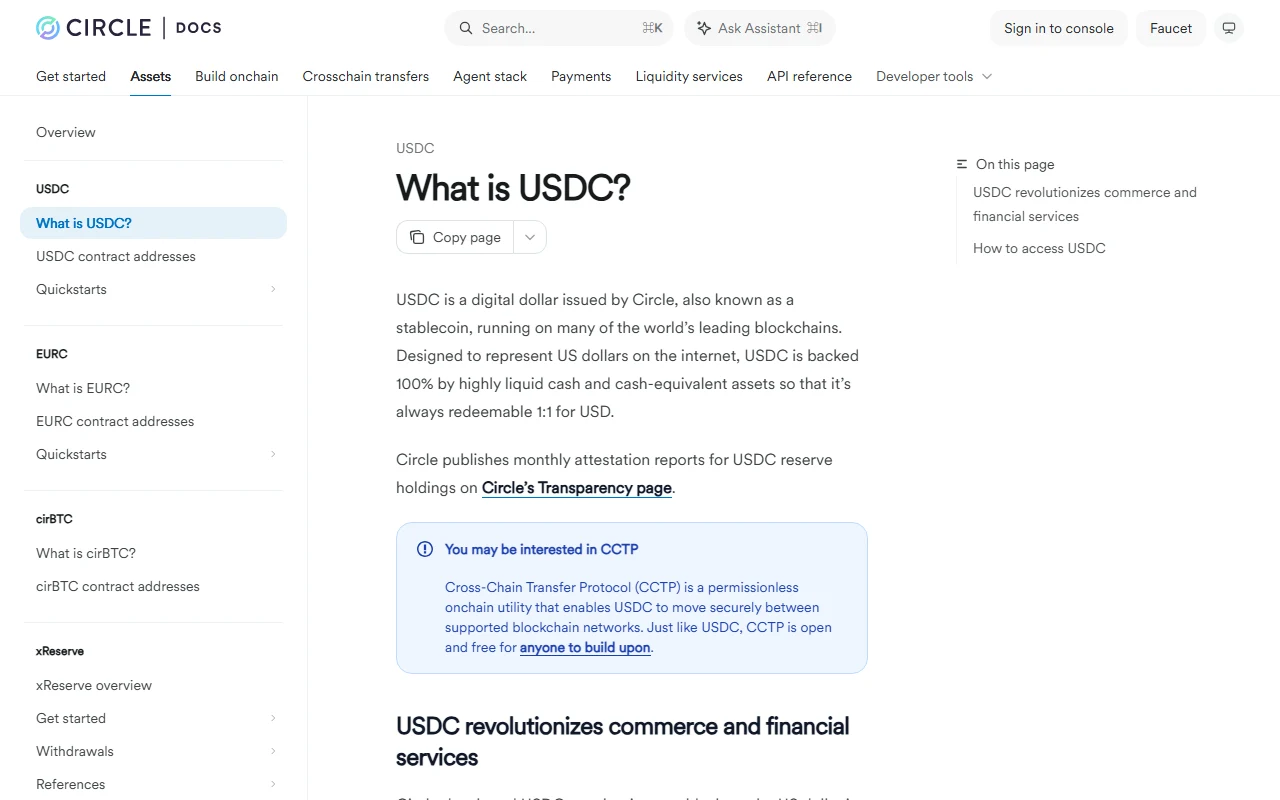
Actual screenshot of Circle's public documentation, captured on September 14, 2026, without signing in. The 1:1 redemption wording must be read alongside eligibility requirements and applicable terms; it does not give every holder an unconditional route to receive dollars from the issuer.
Two transactions are easy to confuse: selling tokens to another market participant and redeeming tokens with the issuer when eligible. They involve different counterparties, fees, and requirements. Circle's USDC terms for holders outside the European Economic Area make direct redemption conditional on the relevant Circle Mint account requirements. They also state that USDC's price on third-party platforms is not guaranteed to remain at one dollar. Holders in the EEA should instead consult the separately applicable USDC White Paper.
You therefore cannot treat “100 USDC” as if it were already “100 USD available for a bank withdrawal.” Check whether your service offers a lawful sale or redemption route that you can use, then verify the asset and net amount you will receive. USDC illustrates the distinction here; its terms do not establish the rules for USDT or any other stablecoin.
Trace the difference through your asset breakdown
Use your platform's official app or website to find the following information. Labels vary between services; there is no reason to follow an unfamiliar link simply because it promises an exact button name.
- Read the asset breakdown. Note each asset's ticker, actual quantity, and estimated dollar value. Do not copy only the headline total.
- Find where each asset is held. Distinguish ordinary account balances, funds committed to open orders, yield products, and external self-custody wallets. Check the platform's field description to learn which of these its overview includes. If you use Binance, see the differences between Spot, Funding, and Binance Wallet.
- Find the reason for any restriction. Read available, locked, pending, or redemption-in-progress balances alongside the original notice. For assets committed to an open order, wait for cancellation to be confirmed before checking availability again. Follow the rules of a yield product rather than assuming immediate redemption.
- Check the trade record. Receiving USDT after selling BTC means you completed a BTC-to-USDT trade. You can only describe that trade as producing fiat currency if the asset received is explicitly listed as USD or another fiat currency. With a partial fill, account separately for the filled and unfilled portions.
- Check the intended withdrawal method. Before submitting, verify the fiat currency, bank method, available amount, fees, limits, and restriction notices actually shown for your account. Stop if no usable method is offered. Owning an asset does not prove you can cash it out through a particular bank.
Being able to trade is not always the same as being able to transfer out. For example, Coinbase's available-balance explanation says cash deposits may be on hold: crypto bought with those funds can be traded on Coinbase while sending it out remains restricted. This is a platform-specific example, not a basis for assigning the same hold period elsewhere. Follow the reason and release conditions in your own account notice.
Worked example: $1,000 in assets, but only $200 available to withdraw
All figures below are teaching assumptions, not live prices or any platform's fee schedule. Suppose an account has no leverage and no assets other than these:
| Asset | Quantity and assumed valuation | Displayed dollar value |
|---|---|---|
| BTC | 0.005 BTC × 80,000 USD/BTC | 400 USD |
| USDC | 300 USDC × 1 USD/USDC | 300 USD |
| USD cash balance | 300 USD, of which 100 USD is temporarily restricted | 300 USD |
| Total | 400 + 300 + 300 | 1,000 USD |
If the chosen method withdraws only the existing USD cash balance, and there are no other restrictions in this example, the eligible amount is:
300 USD cash balance − 100 USD restricted = 200 USD
The $400 BTC valuation is not $400 in cash. Nor has the 300 USDC already been sold for 300 USD. If you choose to sell either asset, you must check the execution price, the currency or token received, fees, and availability again. You cannot add their estimated values directly to the existing withdrawable cash balance.
Now assume you request a 200 USD withdrawal with a 2 USD fee deducted from that amount, and no other fees. The expected net receipt is 200 − 2 = 198 USD. The calculation changes if the fee is charged separately, the receiving bank converts the currency, or another charge applies. Our explanation of trading fees, spreads, and slippage can help you distinguish these costs; its Binance-specific rules apply only in the circumstances it identifies.
What to do when the figures still do not match
- There is a dollar valuation but no dollar cash balance: return to the asset list and check the tickers. Do not treat a lower valuation as proof that dollars were deducted. Check separately whether the quantities, prices, or transaction records changed.
- You sold crypto but received no fiat currency: check the received asset in the trade record. You may have exchanged it for another cryptoasset, received only a partial fill, or submitted an order that has not filled.
- There is a cash balance, but less is available to withdraw: identify the corresponding restricted amount, pending request, or method limit. If the reason is unclear, save the error and relevant records, then ask through official support for the reason, release conditions, and next step. Do not test the problem by repeatedly submitting orders.
- The withdrawal says successful, but the bank shows nothing: compare the withdrawal record, receiving currency, and bank transaction history, then follow the original payment method's enquiry procedure. A portfolio valuation, transfer screenshot, or payment notification is not a substitute for money actually arriving in your own bank account.
You have completed the balance check when you can explain which assets you own, how much of each, what is restricted, which withdrawal method is available, and how its fees are deducted. If your next step is specifically to cash out from Binance, use the bank and P2P cash-out checks after selling crypto and confirm the result against the available balance in your own bank account.
This is general educational information, not investment advice. Sources were checked on September 14, 2026. Eligibility, balance restrictions, and withdrawal methods can change; check the current conditions for your own account before acting.